
Last Update: August 20, 2026 | Reviewed by Continental Tire Product/Technical Specialists
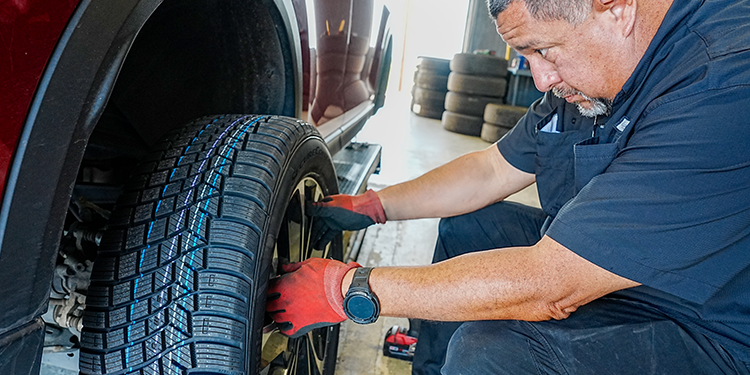
Tire rotation moves tires from one position to another on your vehicle to equalize wear patterns, maximize tire life and maintain balanced handling performance.
This guide is for vehicle owners who want to maximize tire lifespan, maintain even tread wear, and understand which rotation pattern matches their drivetrain. The most important action is rotating your tires every 5,000 to 7,000 miles using the correct pattern for your vehicle type.
Why should I rotate my tires?
Tire rotation equalizes wear patterns across all four tires, maximizing tire lifespan, maintaining balanced handling, and avoiding the premature replacement of only the most worn tires.
Uneven Wear Without Rotation
Different wheel positions create different wear patterns. Front tires on front-wheel-drive vehicles typically wear faster than the rear tires due to steering and power transmission loads. Regular rotation distributes this wear evenly across all four tires. Rear tires on rear-wheel-drive vehicles experience similar accelerated wear.
Without rotation, you face two expensive problems:
- Premature tire replacement: Front tires may need replacement much sooner while rears still have tread remaining.
- Buying tires in pairs: Instead of replacing all four at once with predictable costs, you replace two front tires, then two rear tires later, doubling the service appointments and often paying more per tire.
Extended Tire Life
Regular rotation extends total tire life by distributing wear evenly. For example, a tire set rated for 50,000 miles could reach even higher mileage with proper tire rotation.
Maintained Performance and Safety
Even tread depth across all four tires provides:
- Consistent handling: Vehicle responds predictably in turns and emergency maneuvers
- Balanced traction: All four tires grip equally in rain, snow, or dry conditions
- Reduced hydroplaning risk: Even tread channels water away uniformly
- Extended warranty coverage: Many tire warranties, including Continental’s, require documented rotation to remain valid.
Improved Fuel Economy
Evenly worn tires maintain optimal rolling resistance. Tires with even wear help maintain consistent rolling resistance and fuel efficiency. Uneven tire wear increases rolling resistance, forcing the engine to work harder and consume more fuel. Periodic tire rotation promotes even tread wear and helps all four tires perform efficiently.
Key Takeaways
- Rotation extends tire service life
- Prevents uneven replacement cycles
- Maintains balanced handling and safety
- Required for warranty coverage
- Costs $20 to $50 but saves hundreds in premature replacement
How often should I rotate my tires?
Rotate your tires every 5,000 to 7,000 miles or every six months, whichever comes first, following the rotation schedule in your vehicle owner’s manual.
Standard Rotation Interval
Continental recommends rotating tires every 5,000 to 7,000 miles for most vehicles. This interval prevents noticeable uneven wear from developing while aligning with typical oil change schedules. A practical schedule is rotating tires with every other oil change if you change oil every 5,000 miles.
For low-mileage drivers who don’t reach 5,000 miles in six months, rotate based on time rather than mileage. Six-month intervals ensure tires don’t develop position-specific wear patterns even with limited driving.
To maintain eligibility for certain Continental tire warranties, rotate your tires every 6,000–7,000 miles and keep a completed Rotation Schedule as proof of service.
Vehicle-Specific Intervals
Some vehicles require more frequent rotation:
- Performance vehicles: Every 3,000 to 5,000 miles due to aggressive driving and softer tire compounds
- Heavy trucks and SUVs: Every 5,000 miles due to increased weight stress
- All-wheel-drive vehicles: Every 3,000 to 5,000 miles to prevent drivetrain stress from uneven tire circumference.
Check your vehicle owner’s manual for manufacturer-specific intervals. Some automakers specify exact mileage requirements that must be followed for warranty coverage.
Signs You’ve Waited Too Long
If you notice these symptoms, rotate immediately and reduce future intervals:
- Visible tread depth difference between front and rear tires (more than 2/32-inch variation)
- One-sided wear on front tires
- Vehicle pulling slightly to one side
- Road noise increasing from front tires
Rotation Documentation
Keep records of every rotation including date, mileage, and service location. Documentation proves warranty compliance and helps track tire performance. Many tire retailers stamp service records or provide digital tracking.
Quick Answer
- Standard interval: Every 5,000 to 7,000 miles.
- Time-based: Every six months minimum.
- With oil changes: Every other service.
- Performance/AWD: Every 3,000 to 5,000 miles.
- Always document: Keep service records.
What rotation pattern should I use?
Use the forward cross pattern for front-wheel drive, the rearward cross or X-pattern for rear-wheel drive, and the cross pattern or side-to-side swap for all-wheel drive, adjusting for directional tires which can only move front to back on the same side.
Front-Wheel Drive (FWD) Pattern
Forward cross: Front tires move straight back to rear positions (left front to left rear, right front to right rear). Rear tires cross to opposite front positions (left rear to right front, right rear to left front). This pattern helps compensate for the faster wear experienced by front tires while promoting more even tread wear across all four tires.
Rear-Wheel Drive (RWD) Pattern
Rearward cross: Rear tires move straight forward to front positions (left rear to left front, right rear to right front). Front tires cross to opposite rear positions (left front to right rear, right front to left rear). This counteracts the power delivery wear on rear tires.
X-pattern alternative: All four tires swap to diagonal opposite positions (left front to right rear, right front to left rear, left rear to right front, right rear to left front). Effective for vehicles with even wear distribution.
All-Wheel Drive (AWD) and Four-Wheel Drive (4WD) Pattern
Cross pattern: Same as X-pattern above, swapping all tires to diagonal opposites. AWD systems stress all four tires similarly, requiring maximum position variation to equalize wear.
Side-to-side swap: Left tires move to right positions, right tires move to left positions, maintaining front and rear locations. Used when tires show specific front or rear wear characteristics.
Directional Tire Pattern
Front-to-back only: Directional tires with V-shaped tread patterns designed to rotate in one direction must stay on the same side. Left front moves to left rear, left rear to left front. Same for right side. This pattern is less effective at equalizing wear but required by tire design.
To rotate directional tires to opposite sides requires dismounting and remounting on the opposite wheels, which most shops charge extra for and is rarely worth the cost.
Staggered Fitment Pattern
No rotation possible: Vehicles with different size tires front and rear (common on performance cars) cannot rotate tires. Front tires stay front, rear tires stay rear throughout their lifespan. This results in replacing front and rear tires separately.
What To Do Next
Check your tire sidewalls for directional arrows indicating rotation direction. If present, you have directional tires requiring front-to-back rotation only. If no arrows appear, identify your drivetrain (FWD, RWD, or AWD) from your owner’s manual and use the corresponding cross pattern. When unsure, consult a tire professional to avoid incorrect rotation.
Can I rotate tires myself?
Yes, you can rotate tires yourself if you have a quality jack, jack stands, torque wrench, and wheel chocks, but professional rotation costs $20 to $50 and includes safety inspections most DIY rotations miss.
Required Tools and Equipment
Essential tools:
- Floor jack rated for your vehicle weight (2 to 3 ton capacity for most cars)
- Four jack stands with appropriate weight rating
- Torque wrench (Check your owner’s manual for proper wheel lug torque specification)
- Wheel chocks
- Lug wrench or impact wrench
- Work gloves
Total tool investment: $150 to $300 for quality equipment. DIY rotation saves $20 to $50 per service but requires safe workspace and mechanical knowledge.
DIY Rotation Process
- Park on level, solid surface and engage parking brake
- Loosen lug nuts one full turn before lifting (do not remove)
- Place wheel chocks behind wheels that will remain on ground
- Lift one corner at a time, support with jack stand before working
- Remove wheel, move to new position following correct pattern
- Hand-tighten lug nuts in star pattern before lowering
- Lower vehicle and torque lug nuts to manufacturer specification in star pattern
- Check tire pressure on all four tires and adjust as needed
Safety Considerations
Critical safety rules:
- Never work under a vehicle supported only by a jack
- Always use jack stands rated for vehicle weight
- Never rotate tires on an incline or soft ground
- Torque lug nuts to exact specification (under-tightening causes wheel detachment, over-tightening damages studs)
- Work on one wheel at a time unless using a four-post lift
Improper jacking can cause vehicle to fall, resulting in injury or death.
If you lack experience with automotive jacking procedures, professional service is safer.
Professional Rotation Advantages
Professional tire rotation includes:
- Visual brake inspection through wheel openings
- Suspension component check for wear
- Tire pressure adjustment to exact specifications
- Tread depth measurement and wear pattern analysis
- Wheel balance check (vibration diagnosis)
- Proper torque application with calibrated tools
- Liability coverage if service causes damage
Many tire retailers offer free rotation with tire purchase or include rotation with other services. The $20 to $50 cost provides value beyond the rotation itself through comprehensive inspection.
When DIY Makes Sense
DIY rotation is practical if you:
- Already own quality jack and stands for other maintenance
- Have safe workspace with level concrete surface
- Understand torque specifications and star-pattern tightening
- Want hands-on vehicle knowledge
- Perform other DIY maintenance regularly
When to Choose Professional Service
Choose professional rotation if you:
- Lack proper equipment or safe workspace
- Are uncomfortable lifting vehicle safely
- Want comprehensive inspection with rotation
- Need documentation for warranty compliance
- Drive a heavy SUV or truck requiring specialized equipment
Important Safety Note
Improper lug nut torque causes wheel detachment while driving. Always use a torque wrench set to manufacturer specifications (Check your owner’s manual for proper wheel lug torque specification). Hand-tightening alone is insufficient. Verify torque specification in your owner’s manual before rotating.
FAQ Section
What happens if I never rotate my tires?
Front tires will wear out faster than rear ones, requiring replacement much sooner while rears still have significant tread. You’ll pay for two separate tire purchases instead of one complete set, costing more overall. Uneven wear also reduces handling balance and may void warranty coverage.
Do I need to balance tires when rotating?
Tire rotation does not require rebalancing. Balancing is only needed when you notice vibration, when installing new tires, or annually as preventive maintenance. However, many shops include free balance checks with rotation and will rebalance if needed.
Can I rotate tires side to side only?
Side-to-side rotation (left to right, right to left) works for some all-wheel-drive vehicles but is less effective than cross patterns at equalizing wear. It’s acceptable for directional tires on the same axle with similar wear. Front-to-back movement is more important for wear distribution on most vehicles.
Should I rotate tires if only one is wearing unevenly?
Yes, but also diagnose why one tire wears differently. Uneven single-tire wear indicates wheel misalignment, suspension damage, or incorrect tire pressure. Rotating without fixing the underlying problem will spread uneven wear to other positions. Get alignment checked before or during rotation.
How do I know my drivetrain type?
Yes, but also diagnose why one tire wears differently. Uneven single-tire wear indicates wheel misalignment, suspension damage, or incorrect tire pressure. Rotating without fixing the underlying problem will spread uneven wear to other positions. Get alignment checked before or during rotation.
Does tire rotation affect my TPMS sensors?
No, tire pressure monitoring system (TPMS) sensors move with the tires during rotation. The vehicle computer automatically detects sensor positions after driving 10 to 50 miles. Some vehicles require TPMS relearn procedures after rotation, which professional shops perform automatically.
Can I mix rotation patterns or skip rotations?
Stick to one consistent rotation pattern. Mixing patterns or skipping rotations creates unpredictable wear and eliminates the benefits of rotation. If you miss a rotation interval, rotate as soon as possible and resume the regular schedule. Missing multiple rotations may create too much wear variation to equalize.